
When a wafer-handling robot returns from repair, the decision to reintegrate it into your production line carries significant risk. A robot that appears functional during a brief inspection can fail within hours under thermal load, contaminate an entire batch through positional drift, or miss critical edge exclusion zones due to uncalibrated end-effectors. According to projected growth data published by Robotics Tomorrow, the global wafer handling robots market is expanding from $1.3 billion in 2023 to an estimated $2.7 billion by 2031, driven by increased precision demands and contamination control requirements in advanced process nodes.
The validation gap between a passing short-duration test and sustained production reliability explains why the semiconductor industry has converged on four specific testing protocols. These tests don’t just verify that a robot works — they prove it will maintain sub-micron accuracy across thermal cycles, withstand production-volume workloads, and operate within cleanroom particle limits throughout its next service interval. Field data consistently shows that skipping any of these four validations increases the probability of premature failure by a measurable margin.
The 4 Critical Tests in 60 Seconds:
- 24-hour repeatability testing — Detects thermal drift and mechanical wear patterns invisible in short-duration tests
- Positional accuracy verification — Validates sub-micron tolerance maintenance under actual wafer loads
- Load/unload cycle stress testing — Simulates production workloads to reveal edge-case failure modes
- Environmental stress validation — Confirms performance stability across cleanroom temperature and humidity variance
Repeatability Testing: 24-Hour Continuous Cycle Validation
The most critical validation test is also the one most frequently shortened or skipped entirely. Industry observations reveal a persistent pattern: repair providers running two to four hours of transfer cycles, seeing acceptable results, and declaring the robot production-ready. This abbreviated approach misses the primary failure mode that emerges only after thermal equilibrium — the point where components reach operating temperature and positional variance stabilizes or, in failed repairs, begins to drift beyond specification.
The repeatability testing standard that has become industry practice involves continuous wafer transfer cycles sustained for a minimum of 24 hours. A reputable semi-conductor robotic repair company implements this extended validation protocol with certified measurement equipment and controlled environmental conditions. During this period, the robot performs pick-and-place operations with loaded wafer carriers while position sensors track movement accuracy at every station — cassette load position, center alignment station, and final unload coordinates.
The test setup replicates production conditions rather than theoretical best-case scenarios. This means using actual FOUP carriers with wafer mass simulation, cycling between atmospheric and controlled environments if the robot operates in an EFEM interface, and maintaining the loadport docking-undocking sequence that introduces mechanical stress on the end-effector assembly. Sensor arrays capture three-dimensional coordinate data at critical waypoints throughout each cycle, building a statistical dataset that reveals variance patterns invisible in sample testing. High-resolution protocols capture positional data every 10-15 cycles, revealing when variance stabilizes or degrades. This granular approach detects bearing wear, belt slip, and calibration drift before catastrophic failure.
The first eight hours of continuous operation represent a thermal stabilization phase where components transition from ambient temperature to sustained operating conditions. Motors and structural elements expand as heat accumulates, causing initial variance that stabilizes after thermal equilibrium — explaining why baseline measurements begin post-hour 8. What separates a successful repair from a premature failure is whether positional variance decreases and stabilizes after hour eight, or continues to drift beyond acceptable limits. A robot with improperly tensioned drive belts, worn bearings, or inadequate lubrication will show progressive degradation as operating temperature rises. This thermal sensitivity becomes the primary diagnostic criterion: sustained performance improvement followed by stable variance indicates mechanical integrity, while continued drift signals component issues that will worsen in production.

The Testing Shortcut That Causes Premature Failures: Accepting a robot after two to four hours of testing is the single most common validation error in the repair cycle. The first hours show false stability — thermal effects haven’t fully developed, and mechanical wear patterns haven’t had time to manifest under sustained load. Robots that pass short-duration tests frequently fail within the first production week when thermal equilibrium reveals hidden drift in bearing assemblies or controller calibration.
Industry-standard acceptance criteria for 300mm wafer handling typically specify positional variance within ±0.025mm (±25 micrometers) across the full 24-hour test period, measured after thermal stabilization. This tolerance reflects the edge exclusion zone requirements for advanced process nodes, where wafer-to-end-effector contact outside the specified grip area causes immediate reject risk. The statistical approach calculates three-sigma limits from the variance dataset, ensuring that 99.7% of all transfer cycles fall within specification. For 200mm wafer systems, tolerances may relax slightly to ±0.05mm depending on process requirements, but the 24-hour duration remains non-negotiable. The test documentation should include timestamped variance plots showing the thermal stabilization curve, steady-state performance data, and statistical process control metrics that demonstrate consistent capability.
The table below compares the four critical validation tests across key evaluation criteria. Each test targets a distinct failure mode, explaining why comprehensive validation requires all four protocols rather than selective testing.
| Test Protocol | Primary Failure Mode Detected | Typical Test Duration | Specialized Equipment Required |
|---|---|---|---|
| 24-Hour Repeatability | Thermal drift, bearing wear, controller calibration stability | 24 hours minimum continuous cycles | Position sensors, thermal monitoring, automated cycling system |
| Positional Accuracy Under Load | End-effector misalignment, structural flex, coordinate deviation | 4 to 6 hours with multiple measurement points | Laser interferometry system, calibrated fixtures, controlled environment |
| Load/Unload Cycle Stress | Mechanical degradation, motor fatigue, edge-case handling failures | 6 to 8 hours high-volume cycling | Simulated FOUP carriers, accelerated wear protocol, failure detection sensors |
| Environmental Stress | Temperature/humidity sensitivity, HVAC variance | 8 to 12 hours controlled environmental cycling | Environmental chamber, temperature/humidity control, extended monitoring |
Positional Accuracy Verification Under Load
While repeatability testing validates consistency over time, positional accuracy verification confirms that the robot achieves the correct coordinates with absolute precision under actual wafer loads. This distinction matters because a robot can be repeatable (consistently returning to the same position) without being accurate (that position may be offset from the programmed coordinates by enough margin to cause wafer misalignment or end-effector contact issues). The combination of both tests provides complete confidence: accuracy confirms correct calibration, repeatability confirms sustained stability.
According to peer-reviewed research indexed on PubMed Central, advanced wafer-centering algorithms enable sub-micron correction during the transfer process, but this capability depends on the robot’s baseline positional accuracy remaining within specification. When repairs involve drive train components, controller replacements, or structural adjustments, recalibration alone doesn’t guarantee accuracy — physical measurement under load conditions provides the only reliable verification.
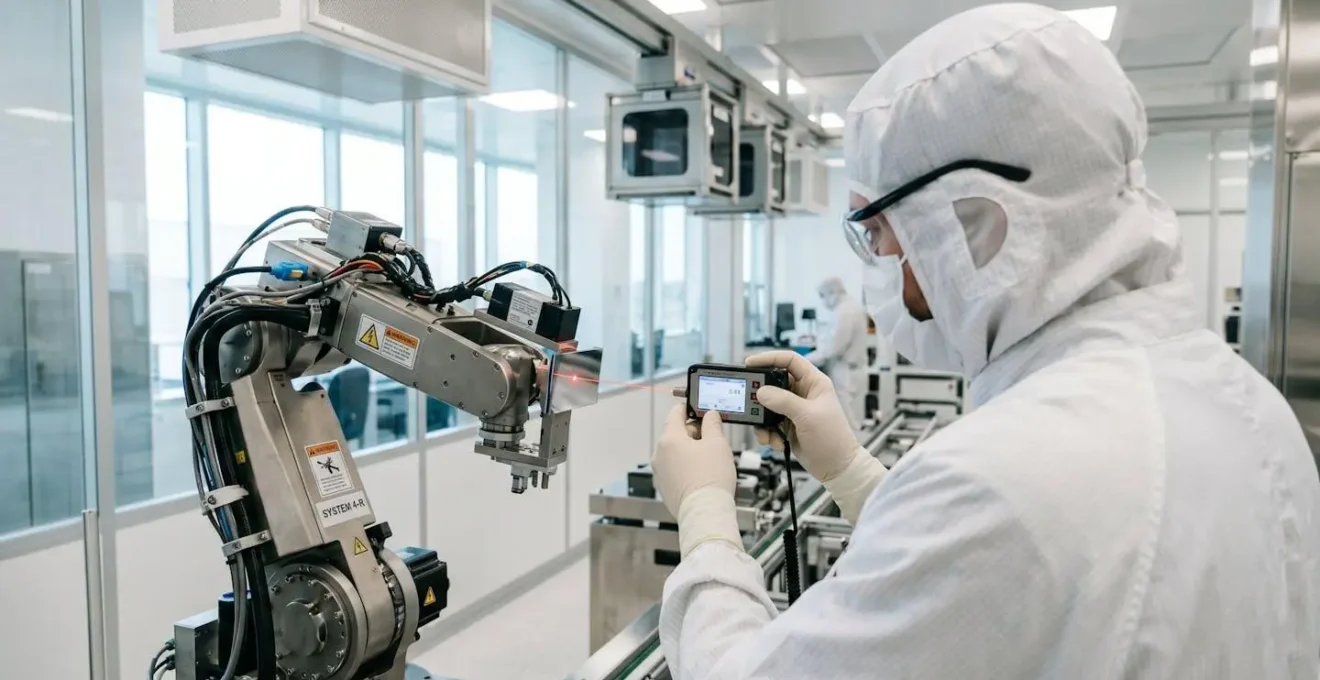
The measurement standard for validating sub-micron accuracy relies on laser interferometry systems capable of resolving positional deviations to within a few micrometers across three-dimensional space. The test fixture positions calibrated targets at the critical waypoints — cassette slot locations, wafer center alignment station, and end-effector retraction coordinates — while the robot executes programmed moves with loaded carriers. The laser system tracks actual versus commanded positions, generating deviation data for X, Y, and Z axes plus rotational alignment. Environmental controls during measurement significantly impact result validity. Temperature stability within ±0.5°C and vibration isolation from adjacent equipment prevent measurement artifacts that could mask actual positional errors or create false failures.
Comprehensive accuracy testing measures positional deviation at multiple points throughout the robot’s working envelope rather than a single home position. This approach catches issues like structural flex under load (where the arm position varies depending on extension distance), uneven wear in drive components (causing accuracy variation across the travel range), and coordinate transformation errors in the controller (producing position-dependent offset patterns). The test protocol typically verifies accuracy at a minimum of eight to twelve distinct coordinates representing the full range of production movements: front and rear cassette positions, multiple slot heights, center transfer station, and retracted home position. Systematic patterns (linear deviation with extension) indicate structural issues or belt tension; random scatter suggests bearing play.
Acceptance thresholds vary based on wafer diameter and process node requirements, reflecting the tighter edge exclusion zones and alignment criticality of advanced manufacturing. For 300mm wafer handling in sub-10nm process nodes, the industry-standard tolerance sits at ±0.025mm (±25 micrometers) as measured across all tested coordinates. This specification ensures that end-effector placement maintains sufficient margin from the wafer edge exclusion zone, typically 2mm to 3mm from the outer diameter where mechanical contact causes immediate scrap risk. For 200mm wafer systems or legacy process nodes with relaxed alignment requirements, tolerances may extend to ±0.05mm without compromising yield, though best practice still recommends the tighter specification when achievable.
Why Accuracy Matters for Yield: At advanced process nodes, wafer-to-end-effector contact outside the edge exclusion zone doesn’t just risk mechanical damage — it can introduce particle contamination that affects the entire batch. A positional accuracy error of 0.1mm on a 300mm wafer with a 2mm exclusion zone represents a 5% reduction in safety margin, multiplying contact risk across thousands of daily transfer cycles. The cumulative effect on yield can exceed the cost of the robot itself within a single production quarter.
Load/Unload Cycle Stress Testing
Durability validation through high-volume cycle testing serves a different purpose than repeatability or accuracy measurement — it accelerates the wear patterns that develop over weeks or months of production use, revealing mechanical weaknesses that won’t appear in short-duration testing. This approach parallels automotive durability protocols, where test vehicles accumulate years of simulated wear in compressed timeframes by running continuous cycles under controlled load conditions.
The test subjects the robot to thousands of consecutive load and unload operations, typically in the range of several thousand cycles over a six to eight hour period. This volume simulates roughly one to two weeks of intensive production use, creating enough mechanical stress to expose bearing degradation, motor brush wear, drive belt slip, and end-effector gripper fatigue. The pass criterion isn’t just completion of the cycle count — it’s completion without positional degradation, mechanical noise increase, or unexpected error codes that signal developing problems. Monitoring during stress testing focuses on trend analysis rather than absolute thresholds. A robot that maintains consistent cycle times, motor current draw, and positional accuracy from cycle 100 to cycle 5,000 demonstrates mechanical integrity. One showing gradual performance degradation — increasing cycle time, rising motor temperature, or growing positional variance — indicates wear patterns that will accelerate in production and likely cause premature failure before the next scheduled maintenance interval.
8.5%
Annual growth rate of the global wafer handling robots market through 2031 (Source: Robotics Tomorrow, 2025), driven by increasing precision and contamination control demands
Field observations from 300mm FAB operations illustrate this detection capability. A legacy atmospheric robot that passed initial 4-hour acceptance testing exhibited subtle bearing noise after 8,000 production load cycles, eventually causing wafer misalignment that triggered contamination alerts. Post-incident analysis revealed that extended stress testing with 10,000+ cycles during repair validation would have detected the progressive bearing degradation through measurable increases in motor current draw and cycle time variance — preventing the costly production interruption and batch loss.
Stress testing effectively detects gradual mechanical wear (bearing degradation, gripper fatigue), thermal issues (motor overheating, controller throttling), and intermittent electrical problems (connector oxidation, cable flex fatigue) — failure types that produce subtle degradation rather than catastrophic breakdowns.
Environmental Stress Validation
Even ISO Class 1-5 cleanrooms experience temperature fluctuations (±1-3°C) from equipment heat loads and HVAC cycling, impacting robot performance if thermal sensitivities weren’t addressed during repair. Humidity control faces similar challenges, with typical variance of ±5% relative humidity despite tight setpoint targets. These environmental shifts, while small, can measurably impact robot performance if thermal expansion coefficients or humidity-sensitive components weren’t properly addressed during repair.
Environmental stress validation deliberately subjects the repaired robot to controlled temperature and humidity cycling that simulates the extreme ranges it will encounter across months of production operation. This accelerated environmental exposure reveals sensitivities that won’t appear during testing at stable ambient conditions — structural components with mismatched thermal expansion rates, bearings with inadequate lubrication for temperature extremes, or electronic assemblies with moisture-sensitive connections that degrade in high-humidity periods.
The test protocol typically cycles between temperature extremes spanning the cleanroom specification range (commonly 20°C to 24°C) while varying relative humidity from 30% to 50%, holding each condition for several hours before transitioning to the next state. The robot performs continuous transfer operations throughout these cycles while position monitoring tracks any correlation between environmental conditions and positional accuracy. A properly repaired robot maintains specification across the full environmental range, while one with thermal sensitivity shows measurable accuracy degradation at temperature extremes.
According to the SEMI E10 and E79 official standards framework, equipment reliability, availability, and maintainability metrics form the foundation for evaluating semiconductor tool performance. These standards provide the measurement methodologies that enable objective comparison between pre-repair and post-validation performance, quantifying improvement in mean time between failures and overall equipment efficiency that justify the repair investment versus replacement alternatives.
Your Repair Validation Checklist: Pass/Fail Criteria
- Confirm 24-hour repeatability test with timestamped data showing ±0.025mm variance (300mm systems)
- Verify laser interferometry measurements at eight coordinates across working envelope, all within specification
- Review cycle stress test showing no degradation across several thousand consecutive operations
- Validate environmental stress testing across temperature and humidity ranges matching cleanroom specifications
- Confirm OEM certified parts with traceability and ISO9001 certification of repair facility
- Ensure 12-month warranty from installation with clear failure-mode coverage and response commitments
The convergence of precision manufacturing demands across industrial sectors — from semiconductor wafer handling to food processing line automation — reflects a shared requirement for validated reliability protocols that prove equipment fitness before production reintegration. While the specific tolerances and contamination controls differ by industry, the fundamental principle remains consistent: comprehensive testing protocols reduce operational risk more effectively than theoretical performance guarantees.
Your Questions About Robot Repair Testing
How long does complete repair validation take from equipment receipt to FAB-ready certification?
The comprehensive four-test validation sequence typically requires 42 to 48 hours of continuous testing time. The 24-hour repeatability test represents the longest single protocol, followed by environmental stress validation at 8 to 12 hours. Total turnaround generally spans three to eight weeks depending on parts availability and testing queue.
Do third-party repair providers meet the same testing standards as OEM service centers?
Testing rigor varies by provider rather than by OEM versus third-party designation. ISO9001-certified third-party facilities with calibrated equipment can meet OEM standards. Verify all four validation tests are performed with quantitative criteria and complete documentation. Confirm the facility uses OEM certified parts, maintains environmental controls during testing, and offers warranty terms comparable to OEM service — typically 12 months from installation.
What happens if a robot fails one of the four validation tests?
Test failure triggers diagnostic analysis to identify the root cause, followed by corrective repair and complete retesting from the beginning of the validation sequence. For example, if a robot passes repeatability but fails positional accuracy verification, the provider typically recalibrates the coordinate system, verifies structural alignment, and checks for bearing play before rerunning the full accuracy protocol. The robot must pass all four tests consecutively before receiving FAB-ready certification — partial passes are not acceptable for production reintegration.
Can the validation testing sequence be shortened to reduce equipment downtime?
Abbreviating the validation protocol directly increases the probability of premature failure in production. The 24-hour repeatability test duration specifically addresses thermal stabilization effects that don’t appear in shorter tests — cutting this to 8 or 12 hours eliminates the detection window for the most common failure mode. Exchange programs offer a better solution, providing a pre-validated replacement unit while your original robot undergoes full testing without impacting your production schedule.
Does comprehensive validation testing void OEM warranties on other equipment components?
Warranty implications depend on the specific OEM terms and whether the robot is still under original warranty coverage. Most wafer-handling robots undergo third-party repair only after OEM warranty expiration or for legacy equipment without OEM support. For robots still under OEM warranty, consult the warranty documentation before proceeding with third-party service — some manufacturers allow third-party repair with OEM parts without voiding coverage, while others require exclusive OEM service. The warranty on the repaired robot itself is separate and typically runs 12 months from installation regardless of other equipment warranty status.
Testing Protocol Limitations
Important considerations:
- These tests represent industry best practices but do not replace OEM-specific validation procedures for proprietary systems
- Acceptance criteria may vary based on specific FAB requirements, process node, and wafer type (200mm versus 300mm configurations)
- Testing equipment calibration and environmental conditions significantly impact result accuracy and validity
Known risks if protocols are inadequate:
- Risk of wafer damage if robot fails prematurely due to insufficient validation before production reintegration
- Risk of contamination event if particle generation exceeds cleanroom class limits during transfer operations
- Risk of production yield loss if positional accuracy degrades below process tolerance during sustained operation
For critical validation decisions involving high-value production equipment, consult a certified equipment engineer or SEMI-accredited testing facility.